Families With Two Parents and Their Biological or Adopted Children Who Share the Same Living Area.

An American nuclear family composed of the mother, father, and their children circa 1955
A nuclear family, uncomplicated family or conjugal family unit is a family unit group consisting of parents and their children (i or more). It is in contrast to a unmarried-parent family, the larger extended family, or a family unit with more than two parents. Nuclear families typically center on a married couple which may have any number of children. There are differences in definition among observers. Some definitions permit only biological children that are full-blood siblings and consider adopted or half and step siblings a office of the immediate family, but others let for a stepparent and whatsoever mix of dependent children including stepchildren and adopted children. Some sociologists and anthropologists consider the nuclear family as the about basic form of social organization,[ citation needed ] while others consider the extended family unit structure to be the most common family construction in nigh cultures and at virtually times.[ citation needed ]
Although the term nuclear family was popularized in the 20th century, information technology has been the dominant form of family unit construction for centuries in Europe.[ commendation needed ] In the United States, the nuclear family became the well-nigh common form of family construction in the 1950s, 1960s and 1970s. Since that time, the number of North American nuclear families is gradually decreasing, while the number of culling family unit formations has increased; this phenomenon is mostly opposed by members of such philosophies as social conservatism or familialism, which consider the nuclear family structure important.
History [edit]
Dna extracted from bones and teeth discovered in a 4,600-twelvemonth-old Stone Age burying site in Federal republic of germany has provided the earliest evidence for the social recognition of a family consisting of two parents with multiple children.[ane]
Historians Alan Macfarlane and Peter Laslett, amidst other European researchers, say that nuclear families have been a master organization in England since the 13th century.[2] The primary arrangement was different from the normal arrangements in Southern Europe, in parts of Asia, and the Center East where it was common for young adults to remain in or ally into the family domicile. In England, multi-generational households were uncommon because young adults would save enough coin to movement out, into their ain household once they married. Sociologist Brigitte Berger argued, "the young nuclear family unit had to be flexible and mobile as it searched for opportunity and property. Forced to rely on their own ingenuity, its members also needed to plan for the future and develop bourgeois habits of work and saving."[3] Berge also mentions that this could exist one of the reasons why the Industrial Revolution began in England and other Northwest European countries. However, the historicity of the nuclear family in England has been challenged by Cord Oestmann.[iv]
Family structures of a mixing couple and their children were present in Western Europe and New England in the 17th century, influenced past church and theocratic governments.[five] With the emergence of proto-industrialization and early capitalism, the nuclear family unit became a financially viable social unit.[6]
Usage of the term [edit]
The term nuclear family first appeared in the early 20th century. Merriam-Webster dates the term back to 1924,[7] while the Oxford English Dictionary has a reference to the term from 1925; thus it is relatively new. While the phrase dates approximately from the Atomic Historic period, the term "nuclear" is not used here in the context of nuclear warfare, nuclear power, nuclear fission or nuclear fusion; rather, it arises from a more than general apply of the noun nucleus, itself originating in the Latin nux, meaning "nut", i.e. the core of something – thus, the nuclear family refers to all members of the family being office of the same cadre rather than directly to atomic weapons.
In its most common usage, the term nuclear family refers to a household consisting of a begetter, a mother and their children[eight] all in 1 household abode.[vii] George Murdock, an observer of families, offered an early clarification:
The family is a social group characterized by common residence, economic cooperation and reproduction. Information technology contains adults of both sexes, at least two of whom maintain a socially approved relationship, and ane or more children, own or adopted, of the sexually cohabiting adults.[9]
Many individuals are part of two nuclear families in their lives: the family of origin in which they are offspring, and the family unit of procreation in which they are a parent.[10]
Alternative definitions have evolved to include family unit units headed by aforementioned-sex parents[11] and perhaps boosted developed relatives who have on a cohabiting parental part;[12] in the latter case, information technology likewise receives the name of conjugal family unit.[11]
Compared with extended family [edit]
An extended group consists of non-nuclear (or "non-immediate") family unit members considered together with nuclear (or "immediate") family unit members. When extended family is involved they also influence children's development simply as much as the parents would on their own.[13] In an extended family resource are usually shared among those involved, calculation more than of a customs aspect to the family unit unit of measurement. This is not limited to the sharing of objects and money, only includes sharing time. For example, extended family unit such as grandparents can lookout man over their grandchildren assuasive parents to continue and pursue careers and creating a healthy and supportive environment the children to abound upward in and allows the parents to have much less stress.[13] Extended families assistance keep the kids in the family unit healthier because of all the resources the kids get now that they take other individuals able to help them and back up them as they grow up.[13]
Changes to family formation [edit]
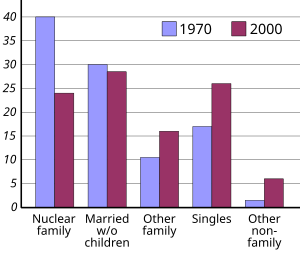
From 1970 to 2000, family arrangements in the US became more diverse with no particular household arrangement prevalent enough to exist identified as the "average"
In 2005, data from the United States Census Agency showed that seventy% of children in the US live in two-parent families,[14] with 66% of those living with parents who were married, and 60% living with their biological parents. The information likewise explained that "the figures suggest that the tumultuous shifts in family unit construction since the belatedly 1960s accept leveled off since 1990".[xv]
When considered separately from couples without children, single-parent families, and unmarried couples with children, the Usa nuclear families appear to constitute a minority of households – with a ascent prevalence of other family arrangements. In 2000, nuclear families with the original biological parents constituted roughly 24.10% of American households, compared with 40.xxx% in 1970.[14] Roughly two-thirds of all children in the U.s. volition spend at least some time in a single-parent household.[16] According to some sociologists, "[The nuclear family] no longer seems acceptable to cover the wide variety of household arrangements we see today." (Edwards 1991; Stacey 1996). A new term has been introduced[ by whom? ], postmodern family, intended to describe the great variability in family forms, including unmarried-parent families and couples without children."[14] Nuclear family households are at present less common compared to household with couples without children, single-parent families, and unmarried couples with children.[17]
In the United kingdom, the number of nuclear families fell from 39.0% of all households in 1968 to 28.0% in 1992. The decrease accompanied an equivalent increase in the number of single-parent households and in the number of adults living lone.[18]
Professor Wolfgang Haak of Adelaide University, detects traces of the nuclear family in prehistoric Central Europe. A 2005 archeological dig in Elau in Deutschland, analyzed by Haak, revealed genetic show suggesting that the thirteen individuals institute in a grave were closely related. Haak said, "By establishing the genetic links between the two adults and ii children cached together in one grave, we have established the presence of the archetype nuclear family in a prehistoric context in Central Europe.... Their unity in expiry suggest[southward] a unity in life."[19] This paper does not regard the nuclear family equally "natural" or as the just model for human family life. "This does non establish the elemental family to be a universal model or the virtually ancient establishment of human communities. For example, polygamous unions are prevalent in ethnographic data and models of household communities take apparently been involving a high degree of complexity from their origins."[19]
Lastly, big shifts in the financial landscape for families has made the historically middle class, traditional, nuclear family structure significantly more risky, expensive and unstable. The expenses associated with raising a family; notably housing, medical care and education, accept all increased very rapidly, particularly since the 1950s. Since and then center class incomes have stagnated or even declined, whilst living costs have soared to the indicate where even two-income households are now unable to offer the same level of financial stability that was in one case possible under the unmarried income nuclear family unit household of the 1950s.[20]
Effect on family size [edit]
As a fertility factor, single nuclear family households by and large take a higher number of children than branch living arrangements co-ordinate to studies from both the Western globe[21] and India.[22]
There accept been studies done that shows a difference in the number of children wanted per household according to where they alive. Families that alive in rural areas wanted to have more than kids than families in urban areas. A report washed in Nihon between October 2011 and February 2012 further researched the result of surface area of residence on mean desired number of children.[23] Researchers of the written report came to the conclusion that the women living in rural areas with larger families were more than likely to want more children, compared to women that lived in urban areas in Japan.
North American conservatism [edit]
For social conservatism in the United States and Canada, the idea that the nuclear family unit is traditional is a very important attribute, where family is seen as the main unit of society. These movements oppose alternative family forms and social institutions that are seen by them to undermine parental authority. The numbers of nuclear families is slowly dwindling in the U.s.a. every bit more women pursue higher instruction, develop professional person lives, and delay having children until later in their life.[24] Children and marriage have go less appealing as many women proceed to face up societal, familial, and/or peer pressure to give up their education and career to focus on stabilizing the home.[24] Equally diversity in the United states continues to increase, it is condign difficult for the traditional nuclear family to stay the norm.[24] Data from 2014 also suggests that unmarried parents and the likelihood of children living with one is also correlated with race. Pew Inquiry Middle has constitute that 54% of African-American individuals will exist single parents compared to 19% of White individuals.[24] Several factors business relationship for the differences in family structure including economic and social class. Differences in educational activity level likewise change the amount of unmarried parents. In 2014, those with less than a high school teaching are 46% more probable to be a single parent compared to 12% who have graduated from college.[24]
Critics of the term "traditional family" indicate out that in well-nigh cultures and at well-nigh times, the extended family model has been most common, not the nuclear family,[25] though it has had a longer tradition in England[26] than in other parts of Europe and Asia which contributed large numbers of immigrants to the Americas. The nuclear family became the well-nigh common course in the U.S. in the 1960s and 1970s.[27]
The concept that narrowly defines a nuclear family as fundamental to stability in modern guild that has been promoted past familialists who are social conservatives in the United States, and has been challenged as historically and sociologically inadequate to describe the complication of actual family unit relations.[28] In "Freudian Theories of Identification and Their Derivatives" Urie Bronfenbrenner states, "Very little is known near the extent variation in the behavior of fathers and mothers towards sons and daughters, and even less about the possible effects on such differential treatment." Petty is known about how parental behavior and identification processes work, and how children interpret sex role learning. In his theory, he uses "identification" with the male parent in the sense that the son will follow the sexual practice office provided by his begetter and and then for the father to be able to identify the difference of the "cross sex" parent for his daughter.
Run across also [edit]
- Astronaut family
- Circuitous family unit
- Family unit relationships
- Hajnal line
- Human bonding
- Immediate family unit
- Intentional customs
- Hindu joint family
- Kibbutz § Kibbutz and child rearing
- Origins of society
- Sociology of the family unit
- Structural functionalism
References [edit]
- ^ "World'south Earliest Nuclear Family Institute". ScienceDaily.
- ^ Berger, Brigitte (2002). The family in the modern age : more than a lifestyle option. New Brunswick, N.J.: Transaction Publishers. p. 100. ISBN0-7658-0121-3. OCLC 48140349.
- ^ "The Real Roots of the Nuclear Family". Institute for Family unit Studies . Retrieved 2017-03-28 .
- ^ Cord Oestmann (1994). Lordship and Community: The Lestrange Family and the Village of Hunstanton, Norfolk, in the First One-half of the Sixteenth Century. Boydell Press. pp. 53–. ISBN978-0-85115-351-3.
- ^ Volo, James M.; Volo, Dorothy Denneen (2006). Family life in 17th- and 18th-century America. Greenwood. p. 42. ISBN978-0-313-33199-2.
- ^ Traditions and Encounters: A Brief Global History (New York: McGraw Hill, 2008).
- ^ a b "nuclear family". Merriam-Webster . Retrieved Oct 5, 2020.
Commencement Known Use of nuclear family
1924, in the meaning divers above - ^ "Nuclear family unit - Definition and pronunciation". Oxford Advanced Learners Dictionary. Retrieved 2021-03-05 .
- ^ Murdock, George Peter (1965) [1949]. Social Structure . New York: Free Press. ISBN978-0-02-922290-4.
- ^ Collins, Donald; Jordan, Catheleen; Coleman, Heather (2009). An Introduction to Family Social Work (3 ed.). Cengage Learning. p. 27. ISBN978-0-495-60188-three.
- ^ a b "Nuclear family". Encyclopædia Britannica Online. Encyclopædia Britannica. 2011. Retrieved 2011-07-24 .
- ^ "Strictly, a nuclear or elementary or conjugal family consists simply of parents and children, though it often includes one or two other relatives as well, for example, a widowed parent or unmarried sibling of i or other spouse."
Sloan Work and Family Research Network, citing Parkin, R. (1997). Kinship: An introduction to basic concepts. Oxford: Blackwell Publishers. Retrieved Apr eighteen, 2012. - ^ a b c LaFave, Dainel; Thomas, Duncan (March 2012). "Extended family and child well existence" (PDF). Extended Family and Child Well Being.
- ^ a b c Williams, Brian; Stacey C. Sawyer; Carl Grand. Wahlstrom (2005). Marriages, Families & Intimate Relationships. Boston, MA: Pearson. ISBN978-0-205-36674-3.
- ^ Roberts, Sam (February 25, 2008). "Most Children Still Live in Two-Parent Homes, Census Bureau Reports". The New York Times . Retrieved 2008-03-05 .
- ^ "Focus on Michigan's Time to come: Changing Family and Household". July 3, 2007. Archived from the original on July 3, 2007.
- ^ Brooks, David. "The Nuclear Family unit Was a Mistake". The Atlantic. ISSN 1072-7825. Retrieved 2020-10-02 .
- ^ Pothan, Peter (September 1992). "Nuclear family nonsense". Third Way. 15 (vii): 25–28.
- ^ a b Haak, Wolfgang; Brandt, Herman; de Jong, Hylke North.; Meyer, C; Ganslmeier, R; Heyd, V; Hawkesworth, C; Pike, AW; et al. (2008). "Ancient Deoxyribonucleic acid, Strontium isotopes, and osteological analyses shed light on social and kinship organization of the Afterwards Rock Historic period" (PDF). PNAS. 105 (47): 18226–18231. Bibcode:2008PNAS..10518226H. doi:10.1073/pnas.0807592105. PMC2587582. PMID 19015520.
- ^ Harvard Mag, The Centre Grade on the Precipice : Rise fiscal risks for American families, by ELIZABETH WARREN, January-Feb 2006
- ^ Nicoletta Balbo; Francesco C. Billari; Melinda Mills (2013). "Fertility in Advanced Societies: A Review of Research". European Journal of Population. 29 (1): i–38. doi:10.1007/s10680-012-9277-y. PMC3576563. PMID 23440941.
- ^ Gandotra MM, Pandey D (1982). "Differences in fertility and family unit planning practices by blazon of family unit". Periodical of Family Welfare. 29 (ane): 29–40.
- ^ Matsumoto, Yasuyo; Yamabe, Shingo (2013-01-xxx). "Family unit size preference and factors affecting the fertility rate in Hyogo, Japan". Reproductive Health. x: 6. doi:10.1186/1742-4755-ten-6. ISSN 1742-4755. PMC3563619. PMID 23363875.
- ^ a b c d e "1. The American family today". Pew Research Center's Social & Demographic Trends Projection. 2015-12-17. Retrieved 2018-04-10 .
- ^ "Parenting Myths And Facts". NPR.org.
- ^ encounter History of the family § Development of household
- ^ "History of Nuclear Families". bebusinessed.com. January 3, 2017.
- ^ Johnson, Miriam K. (ane January 1963). "Sex Role Learning in the Nuclear Family". Child Development. 34 (2): 319–333. doi:10.2307/1126730. JSTOR 1126730. PMID 13957857.
External links [edit]
- The Nuclear Family unit from Buzzle.com
- Early on Human Kinship was Matrilineal past Chris Knight. (anthropological debates as to whether the nuclear family unit is natural and universal).
Source: https://en.wikipedia.org/wiki/Nuclear_family
0 Response to "Families With Two Parents and Their Biological or Adopted Children Who Share the Same Living Area."
Post a Comment